Every roundup of 2026 mobile trends is circling the same idea from a different angle: apps are moving from AI that answers questions to AI that takes actions. The label attached to that shift is "agent," and it is getting attached to a lot of things that are not actually agents.
This is a working definition, a map of where agentic features earn their place inside a real product, and the version of this we would actually build first if you asked us next week.
- A chatbot answers. An agent acts: it reads context, decides what needs to happen, and does it, inside limits you set.
- The trend is real and broad based across the industry, but the useful version of it is narrow: one process, done end to end, not a general assistant bolted onto the whole app.
- On-device versus cloud is a real architecture decision, not a footnote. It changes latency, cost per user, and what you can promise about privacy.
- Guardrails are not a later phase. Approval steps, an audit log and a stop switch are part of the first version, not a v2 feature.
- Ship one agent end to end in about a month. A working feature beats a roadmap slide, and it tells you fast whether the idea holds up against real usage.
Section 01
Chatbot versus agent: the distinction that actually matters
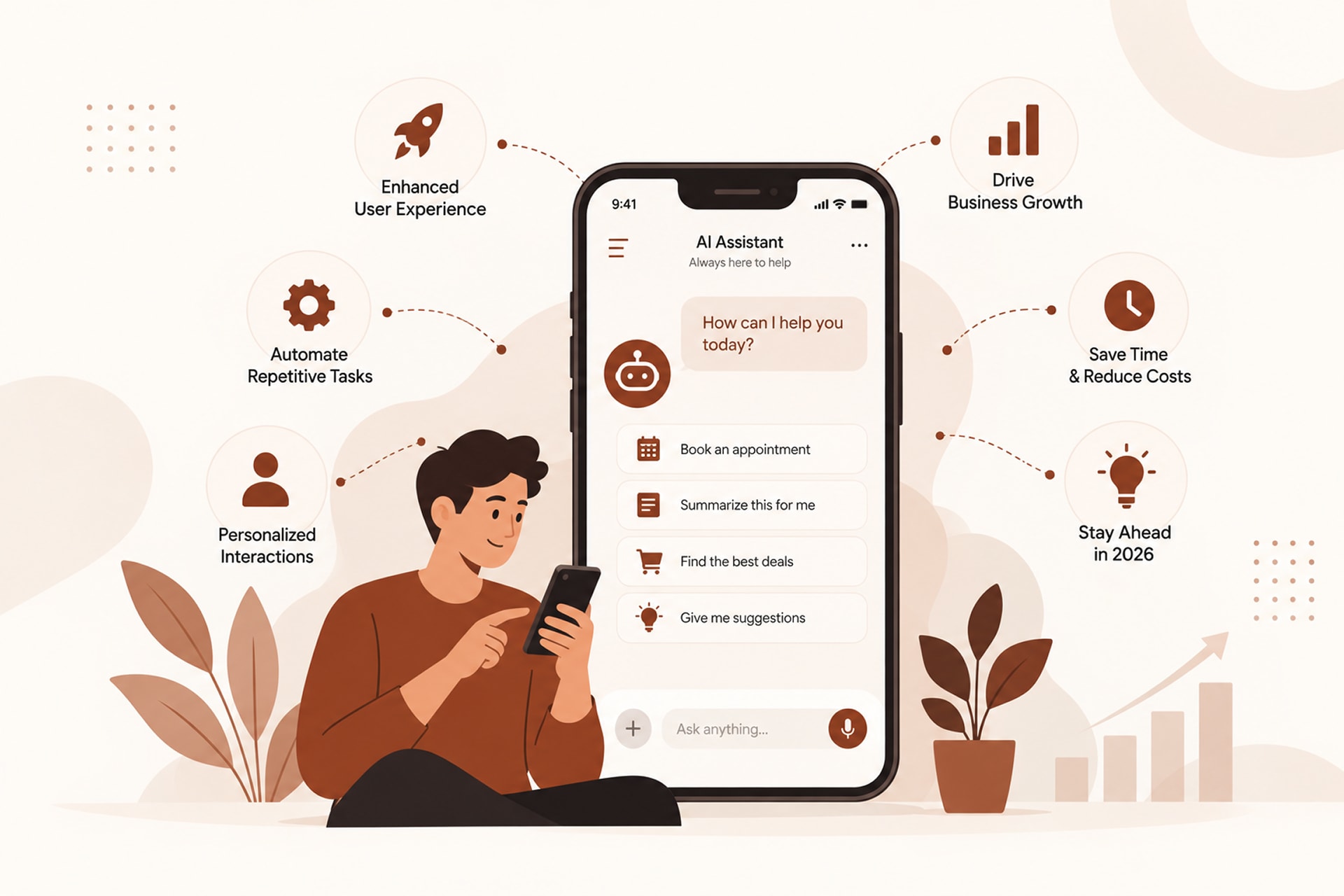
A chatbot is a conversation layer. You ask it something, it retrieves or generates an answer, and the interaction ends there. Everything that happens next, the actual booking, the actual refund, the actual update to a record, still runs through the same buttons and forms it always did.
An agent is given a goal, not a question. It reads whatever context it needs, decides on a sequence of steps, and executes them, calling the same APIs a person would tap through by hand. The chat interface, if there is one, is just the way it reports back, not the whole feature.
Section 02
Why this is the trend for 2026 specifically
Three things landed in the same window. Models got reliable enough at multi step tool use to be trusted with real actions instead of just text. On-device and small models got fast and cheap enough to run parts of an agent's reasoning without a network round trip. And people using consumer AI products every day arrived with an expectation that software should do things, not just describe them.
None of that is specific to mobile. What is specific to mobile is that a phone already knows more about the moment than a web app does: where the person is, what they just photographed, what notification they just tapped, what they were doing in the app thirty seconds ago. That context is what makes an agent on a phone genuinely more useful than the same idea on a desktop dashboard.
Section 03
Where agentic features actually belong in an app
The failure mode we see most often is a team trying to build one assistant that understands the whole app. That is a research project, not a sprint. The useful version picks one narrow, well bounded process and automates that end to end.
- Support triage and first response: read the incoming message, classify it, draft or send a reply, and only escalate to a human when confidence is low or the topic is sensitive.
- In app task automation: a user states a goal in one sentence and the agent completes a multi step flow that would otherwise be five screens and a form.
- Personalized recommendations that act, not just suggest: reordering a list, pre filling a cart, scheduling a follow up, rather than showing a static "you might also like" row.
- Voice or text driven flows for anything currently buried in a settings menu or a multi step wizard.
Notice what these have in common: each is one job, with a clear success condition, that a person can currently do by hand. That is what makes it possible to test whether the agent actually got it right.
Section 04
On-device versus cloud AI, and why the choice matters
This is an architecture decision with real consequences, not a implementation detail to defer.
Cloud models
- Stronger reasoning and broader knowledge, useful when the task genuinely needs it.
- A per call cost that scales with usage, which changes your unit economics as the feature grows.
- A network dependency: no connection, no agent, unless you design an offline fallback.
- User data leaves the device, which matters a great deal in regulated or sensitive categories.
On-device or small models
- Near instant response and no per call bill, which matters for a feature used constantly rather than occasionally.
- Works offline, which matters for field, travel and low connectivity use cases.
- A real privacy story: for sensitive processes, the ability to say the data never left the phone is a genuine differentiator, not marketing copy.
- Less raw capability, so it fits classification, extraction and routing tasks better than open ended reasoning.
Section 05
Guardrails belong in version one, not version two
An agent that can act is an agent that can act wrongly. The guardrails are not a hardening pass you schedule after launch, they are what makes it safe to launch at all.
- Approval steps on anything that matters: money movement, deletions, anything sent externally in the user's name.
- A full audit log of every action the agent took and why, so a wrong outcome is explainable rather than a mystery.
- Hard limits on what it is allowed to touch, enforced server side, the same way you would scope an API key.
- A stop switch the user or your team can hit immediately, that actually halts in flight actions rather than just hiding a chat window.
- A confidence threshold below which the agent hands off to a human instead of guessing.
The agent should be able to explain itself. If it cannot say why it did something, it should not have been allowed to do it.
Section 06
Ship one agent in a month, not a roadmap
The teams that get real value from this are not the ones with the most ambitious plan, they are the ones who picked one process and shipped it fast enough to learn from real usage.
- Week 1: pick the single process, define what success looks like, and decide on device versus cloud for that specific task.
- Weeks 2 and 3: build the action layer first, the actual API calls the agent will make, then wire the model on top of it. The plumbing is the hard part, not the prompt.
- Week 4: add the guardrails, run it against real historical cases, and ship it behind a flag to a small slice of users before opening it up.
This mirrors how we scope MVP work generally: one real thing running end to end beats a broad plan that never gets past the deck.
Frequently asked questions
Do we need our own model, or can we use an API from an existing provider?
Almost always the latter to start. Training or fine tuning your own model is rarely justified before you know the feature works. Use an existing provider's API for the cloud portion, and a small on-device model for the parts that need to be instant or offline, then revisit once usage tells you where the real cost or quality pressure is.
How is this different from the automation and chatbot features apps already have?
Most existing chatbot features answer questions or route a request to a human. An agent completes the task itself, end to end, through the same systems a person would use, with a defined success condition you can measure against.
Is this only realistic for large companies with big AI budgets?
No. The scope that works best is narrow by design, one process, not a general assistant, which is exactly what keeps the cost and timeline down. A focused first agent is realistically a one sprint build.
What is the biggest risk in adding an agent to an existing app?
Skipping the guardrails to move faster. An agent with no approval step, no audit log and no stop switch will eventually take an action nobody can explain or undo. Build those in from day one, not after the first incident.