There is a version of app strategy where you build the product, launch it, and move on to marketing. It is intuitive, and it is a reliable way to watch a good app decline over eighteen months without anything obviously going wrong.
Shipping regularly is not about adding features faster. It is about staying compatible, staying visible, and staying in a conversation with the people who use your product. Here is how that translates into retention and revenue, and what a workable cadence actually looks like.
- A visible release cadence signals that the product is alive. Users and stores both read that signal.
- Most of the value in updates comes from fixes and performance, not from new features.
- Every OS release is a compatibility deadline you did not set. Falling behind turns routine work into emergency work.
- Ratings recover when users see their complaints addressed, and rating drives install conversion.
- A predictable small release beats an unpredictable large one, for both users and your own team.
Section 01
What actually happens when you stop shipping
Decline is gradual enough that no single week looks like a problem. Then a year has passed and the numbers have moved a long way.
- Compatibility erodes. Two OS releases land, deprecations bite, and behaviour changes on devices you never tested.
- Small bugs accumulate into a reputation. Individually minor issues become the theme of your reviews.
- Ratings drift down, because the users motivated enough to write a review are usually the frustrated ones.
- Store ranking suffers, since freshness and rating both feed discovery.
- Competitors who did keep shipping now demo better in a side by side comparison.
- The eventual catch up release becomes a large, risky project rather than a routine one.
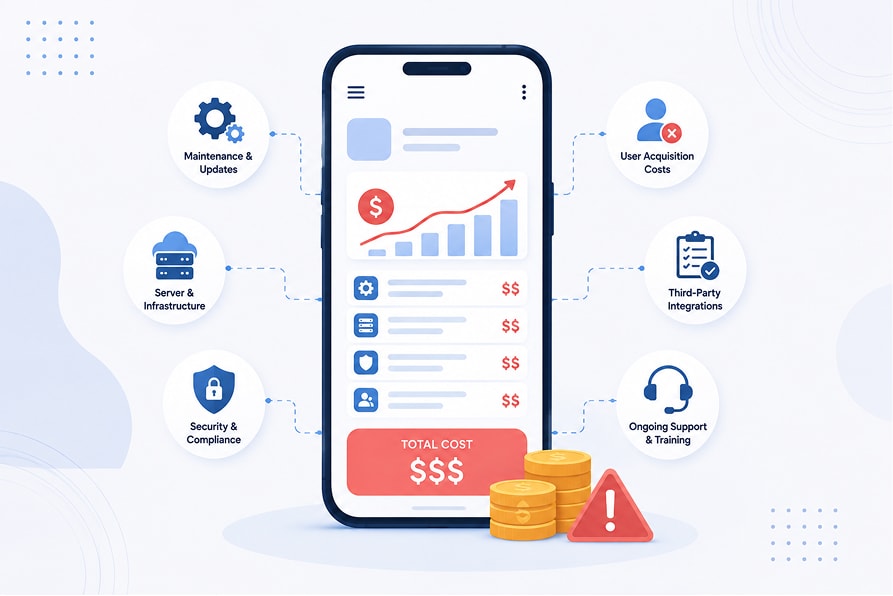
An app does not stay still when you stop working on it. The platform keeps moving, so standing still is a slow reverse.
Section 02
How updates move retention
Retention is the metric updates influence most directly, and the mechanism is less about novelty than people assume.
Users leave for specific reasons: something crashed, a flow was confusing, the app got slow, or the thing they needed was missing. Each of those is addressable, and each fix returns a slice of the users who would otherwise have churned for that reason. Shipping regularly means you are working through that list continuously rather than in one annual push.
- Crash fixes recover the users who hit the crash and have not yet uninstalled.
- Performance work reduces silent abandonment, which never shows up in a support ticket.
- Flow improvements on your worst drop off screen lift activation for every future cohort.
- Requested features returning in a release convert your most engaged users into advocates.
Section 03
What to ship when there is no headline feature
Teams often skip a release because nothing feels big enough to announce. That is a marketing instinct applied to an engineering decision, and it is usually wrong.
- Crashes and errors, ranked by how many users each one affects rather than by how interesting the bug is.
- Performance: cold start, scroll smoothness, and the slowest screen in your analytics.
- The single worst step in your funnel, addressed properly rather than tweaked.
- Dependency and SDK updates, especially any with security advisories attached.
- Compatibility work for the OS release that is currently in beta, ahead of its public launch.
- Small quality of life improvements that reviewers have asked for repeatedly.
Section 04
Choosing a cadence you can actually hold
The right interval depends on your team size and the risk profile of your product, but consistency matters more than frequency. A dependable monthly release beats an ambitious fortnightly one that slips constantly.
- Two to four weeks suits most consumer products, with a hotfix path for anything critical.
- Regulated products often run longer cycles because of review overhead. Plan around that rather than pretending it is not there.
- Keep releases small. Small releases are easier to test, faster to review and safer to roll back.
- Use staged rollout so a problem reaches a fraction of users rather than all of them.
- Protect the cadence when a feature is not ready. Ship without it rather than delaying the release.
Section 05
The link to revenue
The chain from release cadence to revenue is not mysterious, but it does run through several steps, which is why it often gets attributed elsewhere.
Fixes and performance improve retention. Retention increases lifetime value and reduces how much you need to spend acquiring replacements. It also improves your rating, and rating affects both store ranking and the conversion rate from store listing to install, which lowers effective acquisition cost. For subscription products the effect is compounded, because every retained month is recurring revenue you did not have to buy twice.
- Higher retention means each acquired user is worth more, which raises what you can afford to pay for the next one.
- A better rating raises install conversion, so the same ad spend produces more users.
- Fewer bugs means less support load, which is a direct cost as well as a distraction.
- A maintained codebase means new features cost less to build, so the roadmap goes further.
Section 06
Making it sustainable
Teams abandon their cadence when releasing is painful. The fix is almost always process rather than discipline.
- Automate the build and submission pipeline so a release is a routine action rather than a day of work.
- Keep a standing capacity allocation for maintenance so it does not compete with the roadmap each cycle.
- Watch crash free rate and your key funnel steps continuously, so the next release has an obvious agenda.
- Read reviews as a team. They are the cheapest research available and they arrive unprompted.
- Use a single codebase where you can, so a fix ships to both platforms in one cycle rather than two.
Frequently asked questions
How often should we release an app update?
Every two to four weeks works for most consumer products, with an immediate path for critical fixes. What matters more than the exact interval is that it is predictable and that you hold it even when a feature is not ready.
Do frequent updates annoy users?
Not on their own. Most updates install automatically and go unnoticed. What does annoy people is a release that breaks something, or a large update over mobile data. Keep releases small, test properly and roll out in stages.
Does updating actually help app store ranking?
Indirectly and meaningfully. Both stores factor in rating and engagement, and updates influence both by fixing the issues that generate poor reviews. Recency also plays a role in how a listing is presented. Shipping regularly is not a ranking trick, but it improves the inputs that ranking depends on.
We have no new features planned. Is there a reason to release?
Yes. Crash fixes, performance work, dependency patches and compatibility with the next OS release are all worth shipping on their own. Work of that kind often does more for retention than a feature release does, because it removes reasons to leave rather than adding reasons to stay.